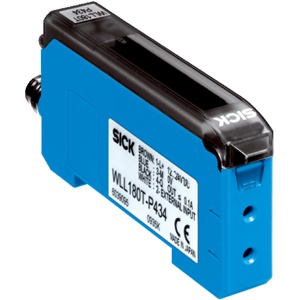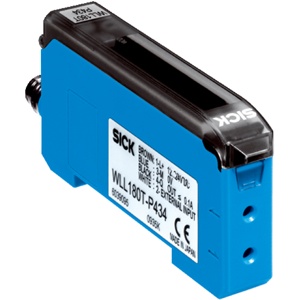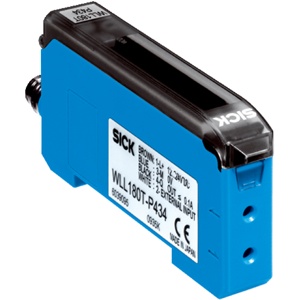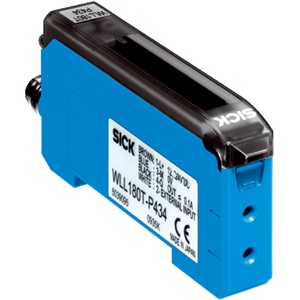
Image for reference. Refer to the datasheet for exact dimensions.
Sick WLL180T-M434 Fiber Optic Sensor
Send your inquiry for Sick 50mA Fiber Optic Sensor WLL180T-M434, 6039101 with cost-effective solutions. Visible red light, Male connector M8, 4-pin, PNP.
- Brand
- Sick
- Model number
- WLL180T-M434
Send this enquiry to IndMALL on WhatsApp — the model and page link are filled in. Add the quantity and your company details, and we connect you with the right suppliers.
Sick WLL180T-M434 technical specifications
| Device type | Fiber-optic sensors |
|---|---|
| Dimensions (W x H x D) | 10.5 mm x 34.6 mm x 71.9 mm |
| Housing design (light emission) | Rectangular |
| Sensing range max. | 0 m ... 20 m (Through-beam system) 2) 3) |
| Sensing range | 0 mm ... 1,400 mm, Proximity system 0 m ... 18 m, Through-beam system 2) 3) |
| Type of light | Visible red light |
| Light source | LED |
| Wave length | 650 nm |
| Indication | 7-segment |
| Supply voltage | N/A |
| Current consumption | 50 mA 3) |
| Switching output | PNP |
| Switching mode | Light/dark switching |
| Response time | ≤ 16 µs, ≤ 70 µs, ≤ 250 µs, ≤ 2,000 µs, ≤ 8,000 µs |
| Switching frequency | 31.2 kHz, 7.1 kHz, 2 kHz, 250 Hz, 62.5 Hz |
| Connection type | Male connector M8, 4-pin |
| Housing material | Plastic, ABS/PC |
| Ambient operating temperature | –25 °C ... +55 °C |
| Ambient temperature, storage | –40 °C ... +70 °C |
| Weight | 20 g |
Overview
Sick WLL180T-M434 Fiber Optic Sensor features rectangular housing, visible red LED light, 650 nm wavelength, and PNP output switching. The WLL180T-M434 supports defined proximity and through-beam sensing ranges and multiple selectable response times for stable optical performance. The WLL180T-M434 Sick 50mA Fiber Optic Sensor is used in conveyors, packaging machinery, automated assembly lines, and inspection stations. Its optical sensing capability supports both short-distance proximity detection and long-distance through-beam monitoring. The PNP output enables direct PLC integration, while selectable switching frequencies allow adaptation to varying machine speeds in industrial automation environments. Its technical consistency and Sick brand reliability support dependable use in production systems.