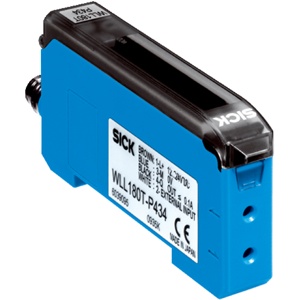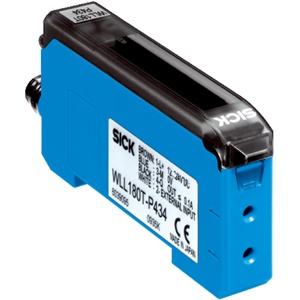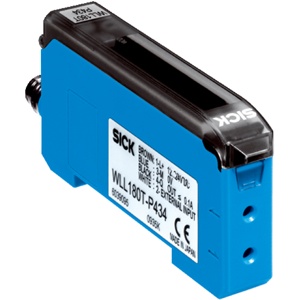
Image for reference. Refer to the datasheet for exact dimensions.
Sick WLL180T-M333S01 Fiber Optic Sensor
Obtain a quote for Sick 650 nm Fiber Optic Sensor WLL180T-M333S01, 6041000 at affordable rates. Visible red light, Cable with connector M8, 3-pin, 0.2 m.
- Brand
- Sick
- Model number
- WLL180T-M333S01
Send this enquiry to IndMALL on WhatsApp — the model and page link are filled in. Add the quantity and your company details, and we connect you with the right suppliers.
Sick WLL180T-M333S01 technical specifications
| Device type | Fiber-optic sensors |
|---|---|
| Dimensions (W x H x D) | 10.5 mm x 34.6 mm x 71.9 mm |
| Housing design (light emission) | Rectangular |
| Sensing range max. | 0 m ... 20 m (Through-beam system) 2) 3) |
| Sensing range | 0 mm ... 1,400 mm, Proximity system |
| Type of light | Visible red light |
| Light source | LED |
| Wave length | 650 nm |
| Indication | 7-segment |
| Supply voltage | N/A |
| Current consumption | 50 mA 3) |
| Switching output | PNP |
| Switching mode | Light/dark switching |
| Response time | ≤ 16 µs, ≤ 70 µs, ≤ 250 µs, ≤ 2,000 µs, ≤ 8,000 µs |
| Switching frequency | 31.2 kHz, 7.1 kHz, 2 kHz, 250 Hz, 62.5 Hz |
| Connection type | Cable with connector M8, 3-pin, 0.2 m |
| Housing material | Plastic, ABS/PC |
| Ambient operating temperature | –25 °C ... +55 °C |
| Ambient temperature, storage | –25 °C ... +70 °C |
| Weight | 25 g |
Overview
Sick WLL180T-M333S01 Fiber Optic Sensor features rectangular housing, visible red LED light, 650 nm wavelength, and PNP output switching. This Sick 650 nm Fiber Optic Sensor uses an LED light source , supports light/dark switching , delivers up to 31.2 kHz switching frequency , and provides a 7-segment indication for industrial automation. The WLL180T-M333S01 supports multiple response time and switching frequency options, enabling controlled optical sensing across proximity and through-beam applications. Its defined sensing ranges support both short-distance proximity detection and long-distance through-beam monitoring. The PNP output allows direct integration with PLC inputs, while selectable response times help adapt the sensor to varying process speeds in industrial automation environments.